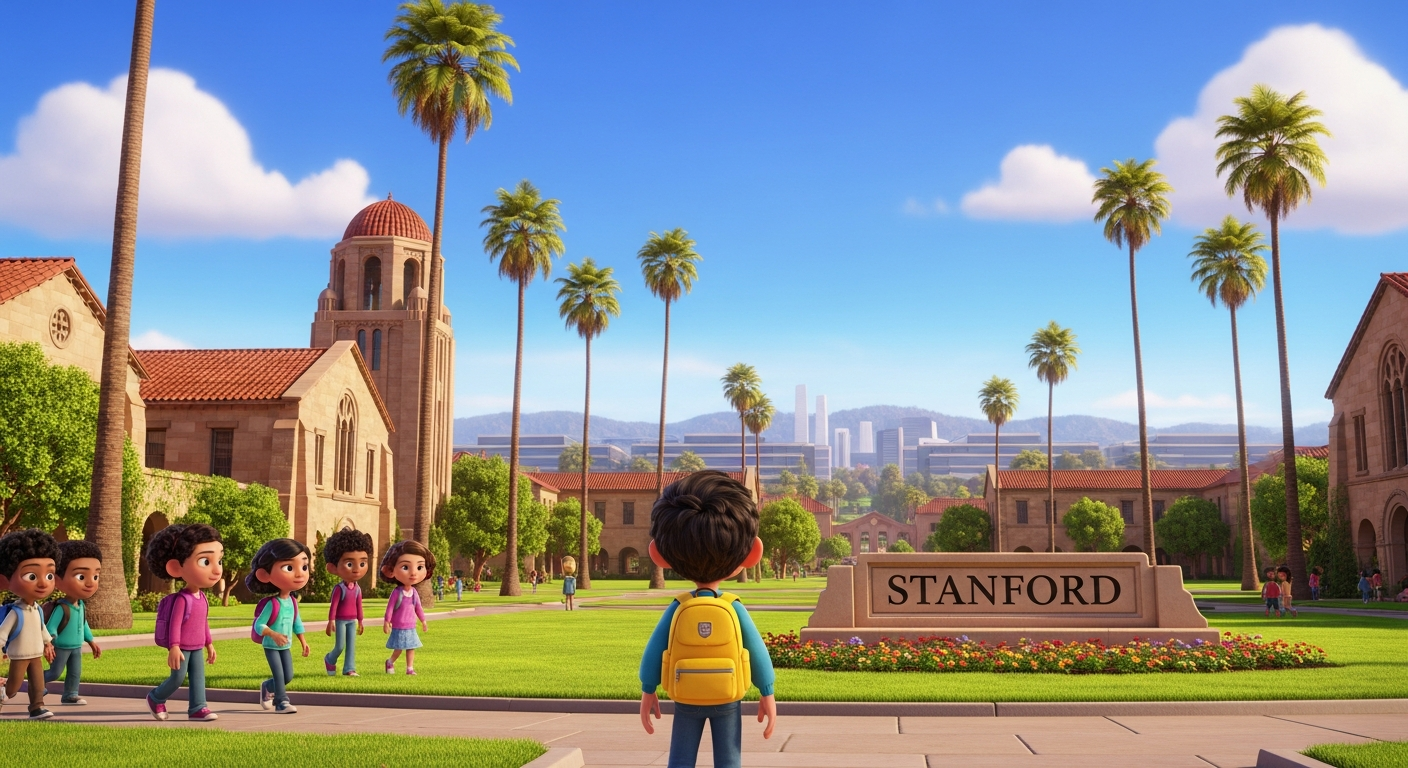
Why do so many of the world’s most famous companies come from the same university?
Walk Around This Campus and You’ll See Something Strange
Imagine walking through Stanford University on a sunny California afternoon. You pass a building where two PhD students once argued late into the night about the best way to organize the entire internet — they went on to create Google. A few minutes later, you walk past a dorm room where a college kid sketched out an app that would let photos disappear after ten seconds — that became Snapchat. Down the road, there’s a spot where four students got tired of not being able to order food delivery, so they built an app and started driving the meals themselves — that became DoorDash.
This keeps happening at Stanford. Over and over again, students walk onto this campus with nothing but a wild idea, and walk off having built something the whole world uses.
Why? What is it about this one school that makes it so special?
It Started with a Broken Heart
The story begins with sadness. In 1884, Leland and Jane Stanford lost their only son, Leland Jr., when he was just 15 years old. Instead of giving up, they turned their grief into something extraordinary: they built a university in his memory, right in the heart of California.
When Stanford University opened in 1891, it was different from the start. The Stanfords didn’t want another school where students just sat and memorized textbooks. They wanted a place where young people learned by doing — by building, experimenting, and getting their hands dirty. That idea would shape everything that came next.
The Professor Who Changed Everything
For decades, Stanford was a good school. But it wasn’t special — not yet. The thing that made Stanford into Stanford was one professor’s stubborn decision.
In the 1930s, an engineering professor named Frederick Terman noticed something frustrating. His best students kept graduating and leaving California to find jobs on the East Coast. All that talent, just gone.
Most professors would have shrugged and moved on. Terman didn’t. He decided that if there were no great tech companies near Stanford, his students should create them.
He mentored two young students named Bill Hewlett and Dave Packard. He found them their first customers. He encouraged them to start a company in a tiny garage just minutes from campus. That company — Hewlett-Packard — became one of the world’s biggest technology firms. And that garage? It’s now a historic landmark called “the Birthplace of Silicon Valley(矽谷).”
Terman kept going. He convinced Stanford to rent land to tech companies, creating a research park right next to campus. Engineers, inventors, and dreamers gathered in the area. Slowly, the neighborhood around Stanford transformed into the most innovative place on Earth — Silicon Valley.
It all started because one professor refused to let his students leave.
Google: A Homework Assignment That Changed the World
Of all the companies born at Stanford, Google’s story might be the most unbelievable.
In 1996, two PhD students named Larry Page and Sergey Brin were given a research assignment: figure out a better way to search the internet. Back then, searching the web was a mess. You’d type something in and get thousands of useless results. Finding what you actually wanted felt like searching for a needle in a haystack.
Page and Brin had an idea. What if, instead of just looking at the words on a page, you looked at how many other pages linked to it? The more links pointing to a page, the more important it probably was. They called their idea PageRank — named after Larry Page.
Their professor wasn’t sure it would work. But Page and Brin kept going. They built a search engine, ran it on Stanford’s computers, and launched it from a Stanford website. It worked so well that it started using too much of the university’s internet bandwidth.
They had to move off campus. So they rented a garage (just like Hewlett and Packard) and turned their homework assignment into a company called Google. Today, billions of people use it every single day. The PageRank patent? It’s still owned by Stanford University.
Snapchat: The Idea Everyone Laughed At
In 2011, a Stanford student named Evan Spiegel stood up in a product design class and presented his idea: an app where photos disappear after you look at them.
His classmates thought it was the worst idea they’d ever heard. Why would anyone want their photos to vanish? The whole point of taking a photo was to keep it forever, right?
Spiegel didn’t give up. He and two friends built the app in their Stanford dorm room. They called it Snapchat. Within a few years, hundreds of millions of people — especially teenagers — were using it every day. It turned out that disappearing photos were exactly what people wanted. Sometimes the “worst idea in the room” turns out to be the best one.
DoorDash: Solving a Problem Between Classes
In 2013, four Stanford computer science students — Tony Xu, Stanley Tang, Andy Fang, and Evan Moore — were working on a class project about small businesses. They went to talk to a local bakery owner in Palo Alto and asked her what her biggest problem was.
Her answer surprised them: delivery. She had great food but no way to get it to customers’ doors. Tons of small restaurants had the same problem.
The four students decided to solve it themselves. They built a simple website, posted menus from local restaurants, and put their own phone numbers on it. When orders came in, they drove the food themselves — between classes, after homework, whenever they could.
That tiny student project grew into DoorDash, a company that now delivers food from hundreds of thousands of restaurants around the world. It all started because four students actually listened to what a small business needed.
The Secret Ingredient: “Just Try It”
Google, Snapchat, DoorDash — these companies are different in every way. But they all share something: they were born in a place where wild ideas are taken seriously.
At most schools, the path is clear: study hard, get good grades, get a safe job. At Stanford, there’s another path that’s just as respected: try your craziest idea and see what happens.
And the most important thing? Failure is not something to be ashamed of at Stanford. If you try something bold and it doesn’t work, people respect you for trying. That might sound simple, but it changes everything. When you’re not afraid to fail, you’re free to try things nobody has tried before.
Stanford’s influence doesn’t stop at campus — graduates later went on to found NVIDIA, Netflix, YouTube, and many more. But the magic starts here, in a school where a homework assignment can become the next Google, and the worst idea in the room can become the next Snapchat.
Did You Know?
- Stanford alumni have created over 39,900 companies, generating $2.7 trillion in revenue — that would be the 10th largest economy in the world, bigger than Canada.
- Stanford’s campus is so huge — 8,180 acres — that most students get around by bicycle. Walking from one end to the other could take over an hour.
- Evan Spiegel (Snapchat) was told his idea was terrible in a Stanford classroom. The company is now worth over $20 billion.
Think About It!
- Evan Spiegel’s classmates all laughed at the idea of disappearing photos. Have you ever had an idea that other people didn’t understand at first?
- The DoorDash founders solved a real problem by actually talking to a small business owner. If you could solve one everyday problem with an app, what would it be?
- Frederick Terman didn’t want his best students to leave California, so he helped them build companies. Who is someone in your life who has helped you chase a big dream?