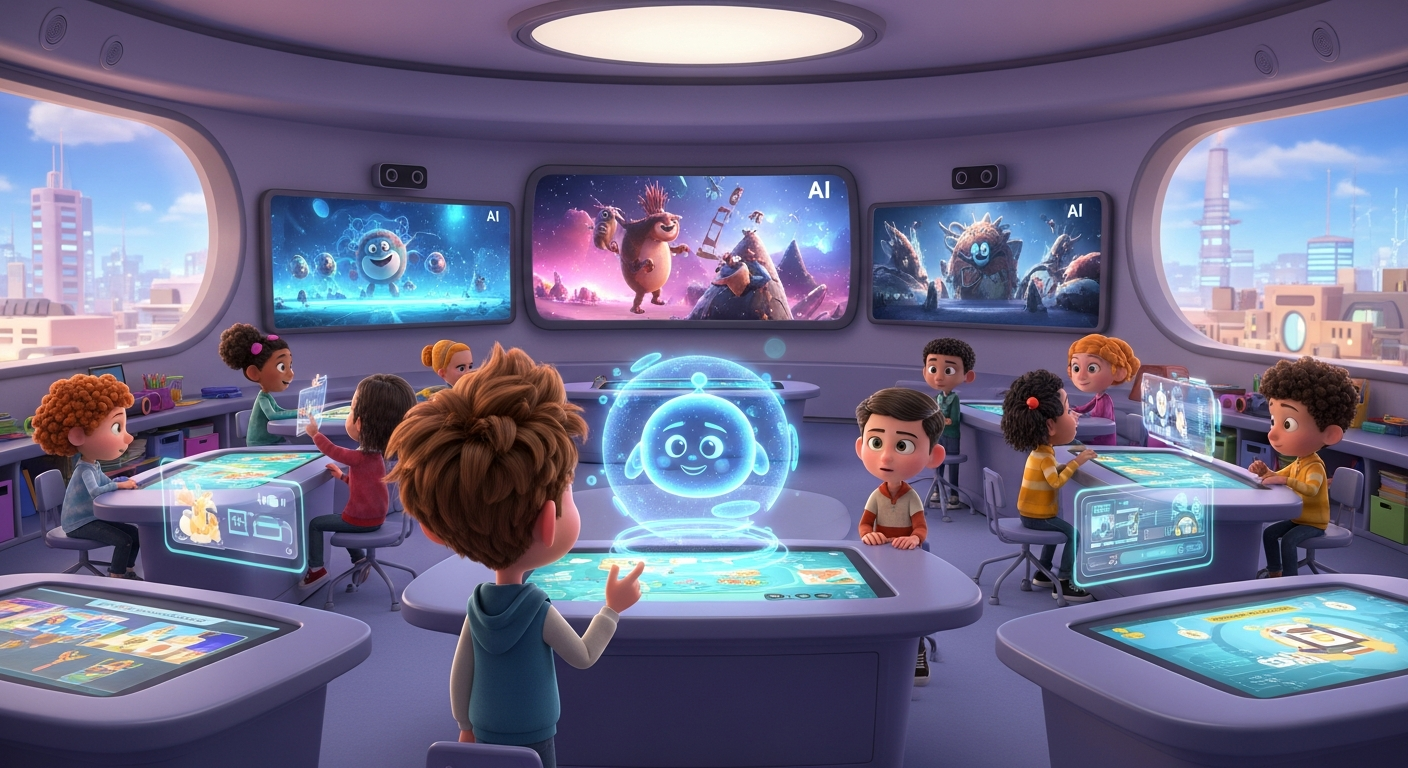
From a chatbot that types to an AI that can see, hear, and talk — OpenAI is building the future, one invention at a time. And the biggest question isn’t what AI can do. It’s what YOU will do with it.
AI That Can See and Hear
For most of history, talking to a computer meant typing on a keyboard. But OpenAI imagined something different: what if you could just talk to AI, like talking to a friend?
In late 2023, OpenAI gave ChatGPT a voice. You could open the app on your phone, press a button, and have an actual spoken conversation with it. You could ask it questions while cooking dinner. You could practice speaking a foreign language with it. You could even ask it to tell you a bedtime story — and it would, in a warm, natural voice.
But that was just the beginning. OpenAI then taught their AI to see. You could point your phone camera at a math problem on your homework, and the AI would explain how to solve it. You could show it a plant in your garden, and it would tell you what kind of plant it was. You could take a photo of a menu in a foreign language, and it would translate it instantly.
An AI that could read, write, see, hear, and speak. Just a few years earlier, that sounded like science fiction. Now it was real, sitting in millions of people’s pockets.
DALL-E: AI That Creates Art
OpenAI didn’t stop at words. They built something called DALL-E — an AI that could create images from words.
You could type “a cat wearing a space suit, floating above Earth, in the style of a watercolor painting” — and DALL-E would create exactly that image. It had never existed before. No artist had painted it. The AI imagined it and drew it, all in a few seconds.
Then came Sora — an AI that could create videos. You could describe a scene, like “a golden retriever puppy playing in the snow in slow motion,” and Sora would generate a realistic video of it.
These tools opened up a whole new world. A kid who couldn’t draw could now create beautiful art for a school project. A small business owner who couldn’t afford to hire a designer could make a professional-looking logo. A filmmaker with a big imagination but a small budget could create scenes that would normally cost millions of dollars.
The AI Race
After ChatGPT’s success, something fun happened.
Tech companies all over the world seemed to hit the “fast forward” button at the same time. Google rushed to launch its own AI assistant. Meta built one too. Big companies and small startups all raced to put AI into their products. It felt like a race — every month, someone was shouting “Our AI is even better now!”
This made AI improve unbelievably fast. Things AI couldn’t do in January became basic features by June. It was like playing a video game where every update gave you a bunch of new abilities.
What Comes Next?
Here’s something wild. AI can already help doctors find diseases in X-ray photos that human eyes might miss. It can help scientists discover new medicines in months instead of years. It can translate conversations between two people who speak completely different languages — in real time, as they talk.
And it’s getting better every single month.
Sam Altman has talked about his biggest dream: building AGI — Artificial General Intelligence. That means an AI that can learn anything a human can. Not just answer questions or draw pictures, but actually figure out brand-new problems nobody has solved before. Imagine an AI that could help design a city on Mars, or find a way to clean plastic out of the ocean, or invent a new kind of battery that lasts forever.
We’re not there yet. Today’s AI is amazing at many things, but it still makes silly mistakes sometimes. It can write a beautiful poem but might get 0.1 + 0.2 wrong. It can explain quantum physics but doesn’t actually understand what it feels like to be surprised.
But here’s what makes this moment so exciting: AI is growing up right now, and you’re alive to watch it happen. The kids who grew up when the internet was new became the people who built Google and Facebook. The kids growing up now — kids like you — will be the ones who decide what AI becomes.
Maybe you’ll use AI to make a video game nobody has imagined yet. Maybe you’ll use it to help animals that are in danger. Maybe you’ll use it to finally crack what dolphins are actually saying to each other.
The real question has never been “What will AI do?” It’s always been: “What will YOU do with AI?”
Did You Know?
- When ChatGPT first launched, so many people tried using it at the same time that OpenAI’s servers kept crashing. The website went down over and over again.
- By 2025, ChatGPT was available in over 50 languages, helping people all around the world.
- GPT-4 took the American bar exam (the test to become a lawyer) and scored in the top 10%. It also passed the SAT, scoring higher than most high school students.
Think About It!
- If you had an AI assistant that could help you learn anything, what’s the first thing you’d want to learn?
- What do you think AI is best at helping people with? And what are some things that should never be left to AI?
- Imagine it’s the year 2040. How do you think AI will be part of your daily life? What will be different from today?