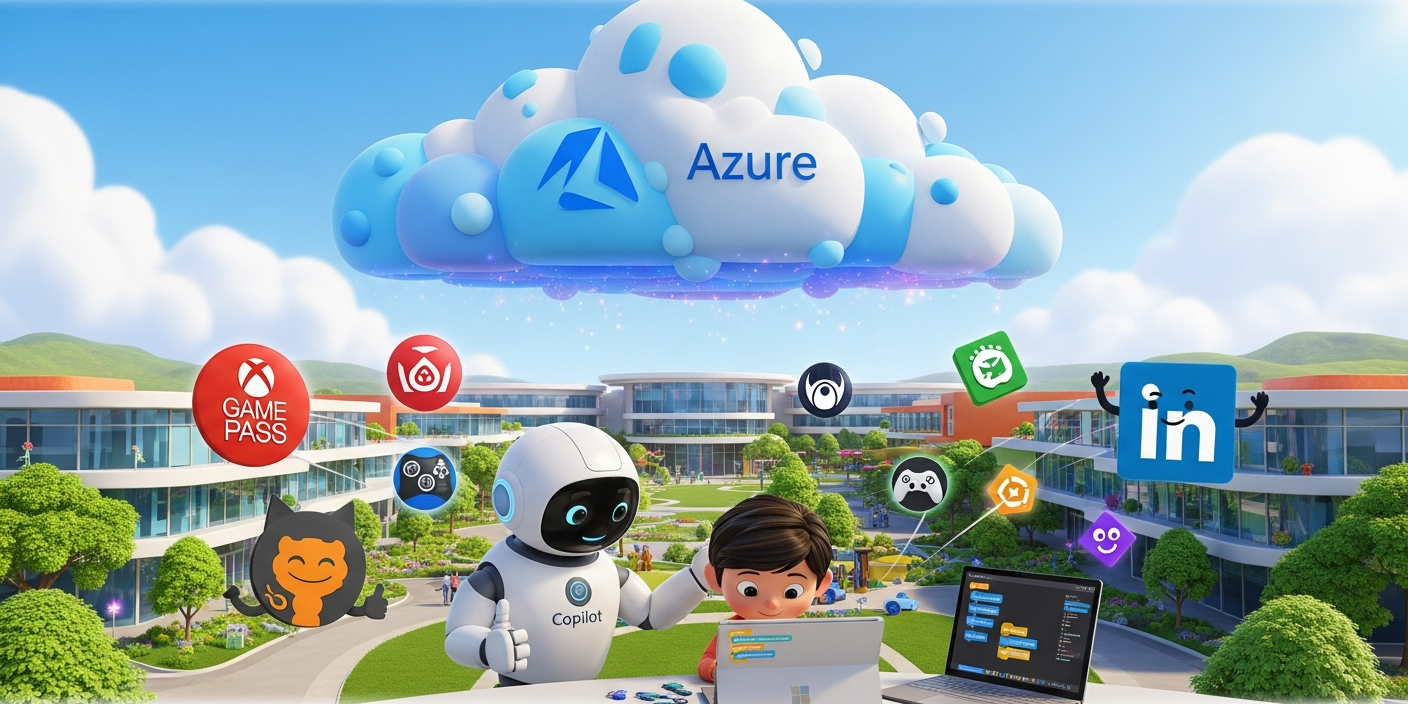
What happens when the world’s biggest software company falls behind — and then reinvents itself in ways nobody saw coming?
The Day the iPhone Changed Everything
On January 9, 2007, Steve Jobs walked onto a stage and pulled a small glass rectangle out of his pocket. It was the iPhone. And it changed everything — not just for Apple, but for Microsoft.
Almost overnight, the world went mobile. People stopped sitting at desks to use computers. They carried the internet in their pockets. And Microsoft? They had no answer.
Microsoft tried to make their own phone — Windows Phone — but almost nobody bought it. Then in 2013, they made an even bigger gamble: they bought Nokia, the company that once made the most popular phones in the world, for $7.2 billion. Microsoft thought they could turn Nokia into an iPhone competitor.
It was a disaster. Nokia phones running Windows couldn’t compete with Apple and Android. It was one of the most expensive failures in tech history.
The company that once ruled the world was stuck. It needed to make some big changes.
A New CEO with a Completely Different Playbook
In February 2014, Microsoft got a new leader: Satya Nadella.
Satya’s first major move shocked the tech world. Instead of forcing everyone to use Windows, he said: Microsoft should work everywhere. He put Microsoft Office on iPhones and iPads. He made Microsoft apps work on Android. He moved Office to the cloud as Microsoft 365, so anyone could use it from any device with an internet connection.
People inside Microsoft were confused. Help Apple users? Work with competitors? That was the opposite of everything they’d been taught.
But Satya had a vision. He didn’t want Microsoft to be the company that controlled your computer. He wanted Microsoft to be the company that helped you get things done — no matter what device you used.
From “Linux Is a Cancer” to “Microsoft Loves Linux”
Then came the changes that truly stunned the world.
Linux is an operating system — just like Windows and macOS, it’s what makes a computer run. Many websites, servers, engineers’ computers, and even some phones and smart devices run on Linux. It had long been seen as an important rival to Windows.
Under Satya’s leadership, Microsoft did a complete reversal. In 2016, Microsoft announced Windows Subsystem for Linux — which meant you could run Linux right inside Windows. The two old enemies, working together on the same computer. Developers couldn’t believe it.
In 2018, Microsoft bought GitHub for $7.5 billion. GitHub is where over 100 million programmers around the world store and share their code. It’s the biggest platform for open-source software — the kind of free, community-built software that old Microsoft used to fight against.
Microsoft also released Visual Studio Code (VS Code), a free code editor, and made it open-source. Today, VS Code is the most popular programming tool in the world. Millions of developers use it every day, on Windows, Mac, and Linux.
The transformation was unbelievable. Microsoft went from the company that wanted to crush open-source software to one of its biggest supporters. It was like watching a strict teacher suddenly become the coolest kid in school.
The Minecraft Surprise
While Satya was transforming the business side, he also made a move that surprised everyone in a different way.
In 2014, Microsoft bought Mojang, the company behind Minecraft, for $2.5 billion. Some people wondered: why would a serious business software company buy a blocky video game?
But look at what kids actually do inside Minecraft. They build entire cities block by block. They recreate ancient Rome. They wire up redstone circuits that work like real electrical engineering. They learn basic programming without even realizing it. Minecraft isn’t a game you play and forget. It’s a place where you create.
Over 350 million copies have been sold — the best-selling video game of all time. More than half of all kids aged 9 to 11 have played it. Microsoft’s customers used to be office workers. Now, for the first time, an entire generation of kids was growing up with a Microsoft product.
And Microsoft didn’t lock it away. They kept Minecraft available on every platform — PlayStation, Nintendo Switch, phones, tablets, everything. Even on competitors’ devices. This was the new Microsoft: open, not controlling.
Then in 2023, Microsoft completed the biggest deal in gaming history: buying Activision Blizzard for $68.7 billion. Activision makes Call of Duty, World of Warcraft, and Candy Crush — games played by hundreds of millions of people. Why spend that much? Because Microsoft was building something called Xbox Game Pass — you pay one monthly fee and get to play hundreds of games, as many as you want. To make Game Pass irresistible, Microsoft needed the games that everyone wants to play. Microsoft went from a company that people laughed at for making Xbox to one of the biggest gaming companies on the planet.
The AI Bet That Changed Everything
But the move that truly defined Satya’s Microsoft was a bet on something most people hadn’t heard of yet: Artificial Intelligence(AI).
In 2019, Microsoft quietly invested $1 billion in a small AI research company called OpenAI. At the time, most people didn’t pay attention. AI was interesting, but it still felt far from everyday life.
Then in November 2022, OpenAI launched ChatGPT. It became the fastest-growing app in history — 100 million users in just two months. Suddenly everyone was talking about AI. And Microsoft was right there, having invested years earlier.
In January 2023, Microsoft poured another $10 billion into OpenAI.
From the Bottom to the Very Top
The numbers tell the story of the turnaround. When Satya became CEO in 2014, Microsoft’s stock price was around $36. By 2024, it was over $400. Microsoft became the most valuable company in the world — worth over $3 trillion.
Think about that journey. A company that was stuck and “uncool,” that lost $7.2 billion on Nokia, that people joked about — transformed into the leader of the AI revolution. All because a new leader had the courage to do the exact opposite of what Microsoft had always done.
Open instead of closed. Helpful instead of controlling. Collaborative instead of combative.
From two teenagers making a bold promise and working day and night to keep it, to the Windows era that put a PC on every desk, to the most unexpected comeback in tech history — Microsoft’s story proves that even giants can reinvent themselves.
Did You Know?
- Microsoft’s former CEO Steve Ballmer once laughed at the iPhone on TV, saying “it doesn’t have a keyboard” and “no business customer would want it.” The iPhone went on to become the most successful product in history.
- In 1976, Bill Gates wrote a famous open letter criticizing people for copying software for free, asking “Who can afford to do professional work for nothing?” Decades later, Microsoft gave away its code editor VS Code for free and shared all the source code with the world. Today it’s the most popular programming tool on the planet.
- GitHub has over 100 million developers — that means about 1 in every 80 people on Earth is writing code on one platform.
Think About It!
- Microsoft went from calling Linux “a cancer” to embracing it completely. Have you ever completely changed your mind about something? What made you change?
- Minecraft started as a small indie game and became the best-selling game ever. If you could create any game, what would it be about?
- Satya Nadella turned Microsoft around by doing the opposite of what the company had always done. Why do you think it’s sometimes better to try something completely new instead of doing what’s always worked?