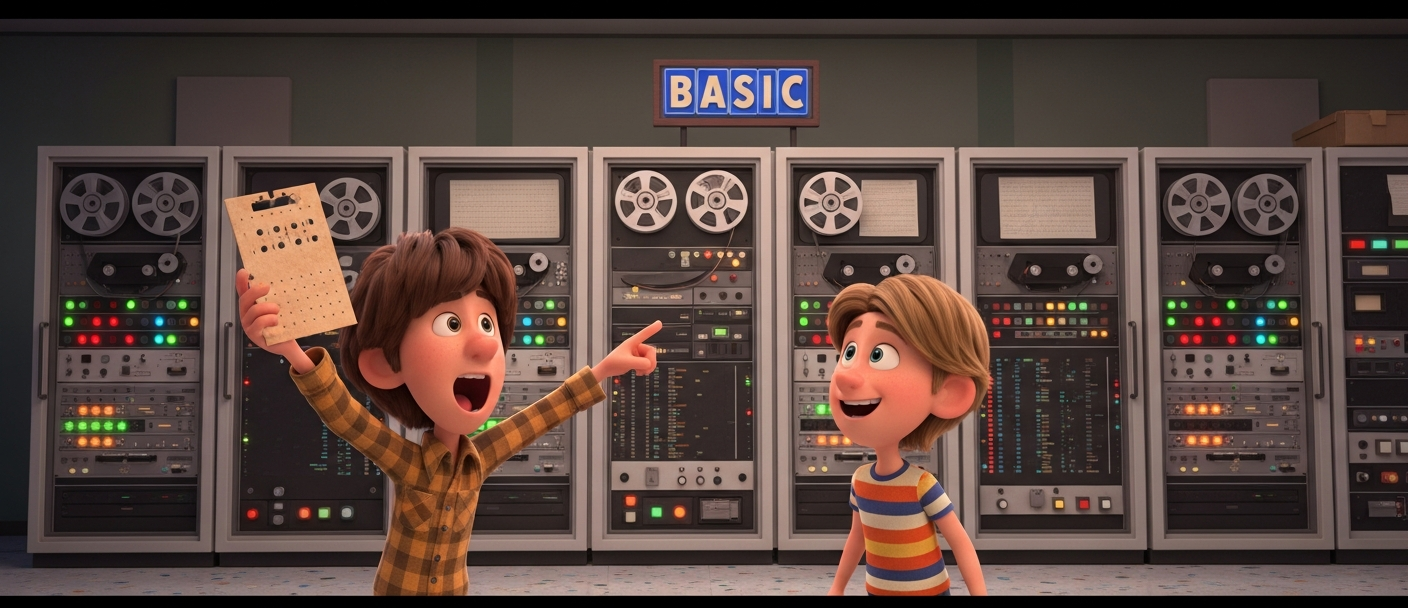
What if two teenagers promised they could build something nobody had ever built — and then stayed up for weeks to make it real?
The Boy Who Couldn’t Stop Asking Questions
Bill Gates was the kind of kid who wanted to know everything.
While other kids in Seattle played outside, young Bill sat in his room reading the encyclopedia — from A all the way to Z. Not just one article. The entire set. When his family played board games after dinner, Bill would study the rules until he found the smartest strategy. When he didn’t understand something, he’d ask question after question until he figured it out.
His curiosity was endless. Science, math, business, history — if there was something to learn, Bill wanted to learn it. His parents noticed early on that their son had a special kind of energy: once Bill got interested in something, nothing could stop him from diving all the way in.
And the thing that captured his attention more than anything else? Computers.
Banned from the Computer Room
This was the early 1970s. Computers were rare, expensive, and huge — most of them filled entire rooms. But Bill’s school, Lakeside Academy in Seattle, had something special: a teletype machine connected to a mainframe computer.
For most students, it was just another piece of school equipment. For 13-year-old Bill, it was the most exciting thing in the world. He spent every spare moment in the computer room — before school, after school, sometimes late into the evening. He wrote his very first program on that machine: a tic-tac-toe game that let you play against the computer.
Bill loved the idea that you could type instructions and make a machine do something new. Every program was a puzzle, and every puzzle had a solution if you were patient enough to find it.
It was at Lakeside where Bill met the person who would change his life: Paul Allen. Paul was two years older, taller, more relaxed, and just as obsessed with computers. Bill was focused and full of energy. Paul was calm and creative. Together, they were the perfect team — spending hours dreaming about what computers could do and daring each other to build things nobody had built before.
The Bluff
In January 1975, Paul Allen was walking past a newsstand in Harvard Square when a magazine cover stopped him cold. Popular Electronics showed the Altair 8800 — the world’s first personal computer kit. It was a metal box with switches on the front. No screen. No keyboard. But to Paul, it was the future.
He ran to show Bill, who was a student at Harvard at the time. They stared at the cover and had the same terrifying thought: the personal computer revolution was starting — and if they didn’t jump in now, they’d miss it forever.
The Altair was exciting, but it had a big problem. It couldn’t really do anything useful. There was no way to write programs for it. It was like having a shiny new car with no engine.
Bill and Paul came up with a bold plan. They called Ed Roberts, the man who built the Altair, and told him they could build a programming language for his computer.
They hadn’t written a single line of code yet. But they were absolutely determined to figure it out.
Eight Weeks of Madness
Now they had to actually build the thing they’d promised.
For the next eight weeks, Bill and Paul barely slept. Bill wrote code in his Harvard dorm room, sometimes collapsing asleep at his desk and waking up to keep coding. Paul worked on making it compatible with the Altair’s hardware — which they didn’t even have. They had to build a simulator to test their code on a different computer, hoping it would work on the real Altair.
Finally, it was time to deliver. Paul flew to Albuquerque, New Mexico, where Ed Roberts’ company was located. He loaded their program into the Altair, typed a command, and held his breath.
It worked. On the first try.
Paul later said it was the single most important moment of his life.
Microsoft Is Born
On April 4, 1975, Bill Gates and Paul Allen officially created their company. They called it Micro-Soft (with a hyphen!) — short for “microcomputer software.” Bill was 19 years old. Paul was 22.
Bill dropped out of Harvard to focus on Microsoft full-time. His parents were worried, but Bill was certain. He saw something most people didn’t: every computer in the world would need software, and Microsoft would be the company to make it.
In the early days, Microsoft was tiny — just a handful of people crammed into a small office in Albuquerque. They wrote programming languages for different small computers. It wasn’t glamorous, but it was the foundation of everything that came next.
The Deal That Changed History
In 1980, a giant came knocking. IBM — the biggest, most powerful computer company in the world — was secretly building its first personal computer. They needed an operating system. An operating system is the basic software that makes a computer work — it starts up when you turn on the machine and lets you run other programs.
IBM asked Microsoft if they could provide one. There was just one problem: Microsoft didn’t have an operating system.
But Bill Gates said yes anyway. Sound familiar? Just like with the Altair, Bill made a bold promise — and then raced to deliver.
He quickly found a small company nearby that had built a basic operating system called QDOS (which stood for “Quick and Dirty Operating System” — seriously). Microsoft bought it for just $50,000, improved it, renamed it MS-DOS, and licensed it to IBM.
Here’s the genius part: Bill didn’t sell MS-DOS to IBM. He licensed it. That meant IBM could use it, but Microsoft kept ownership and could sell it to other computer makers too.
When the IBM PC became a huge success, every other company wanted to make similar computers. And every single one of them needed MS-DOS. Microsoft went from a small software company to the company that powered almost every personal computer on Earth.
Two teenagers made a bold promise and worked day and night to keep it. Then they did it again. And the second time, it changed history.
Did You Know?
- Bill Gates read the entire World Book Encyclopedia as a kid — from A to Z. His curiosity about the world started long before he ever touched a computer.
- Bill wrote his first computer program at age 13. It was a tic-tac-toe game that let you play against the computer.
- When Bill dropped out of Harvard, he told his parents it was temporary. He never went back — though Harvard gave him an honorary degree in 2007.
Think About It!
- Bill and Paul promised they could build something before they’d even started. Then they worked incredibly hard to make it real. Have you ever taken on a big challenge that seemed almost impossible at first?
- Bill Gates was so curious that he read an entire encyclopedia for fun. What’s something you’re so curious about that you could spend hours learning about it?
- Bill’s decision to license MS-DOS instead of selling it made all the difference. Can you think of a time when a small decision led to a really big result?