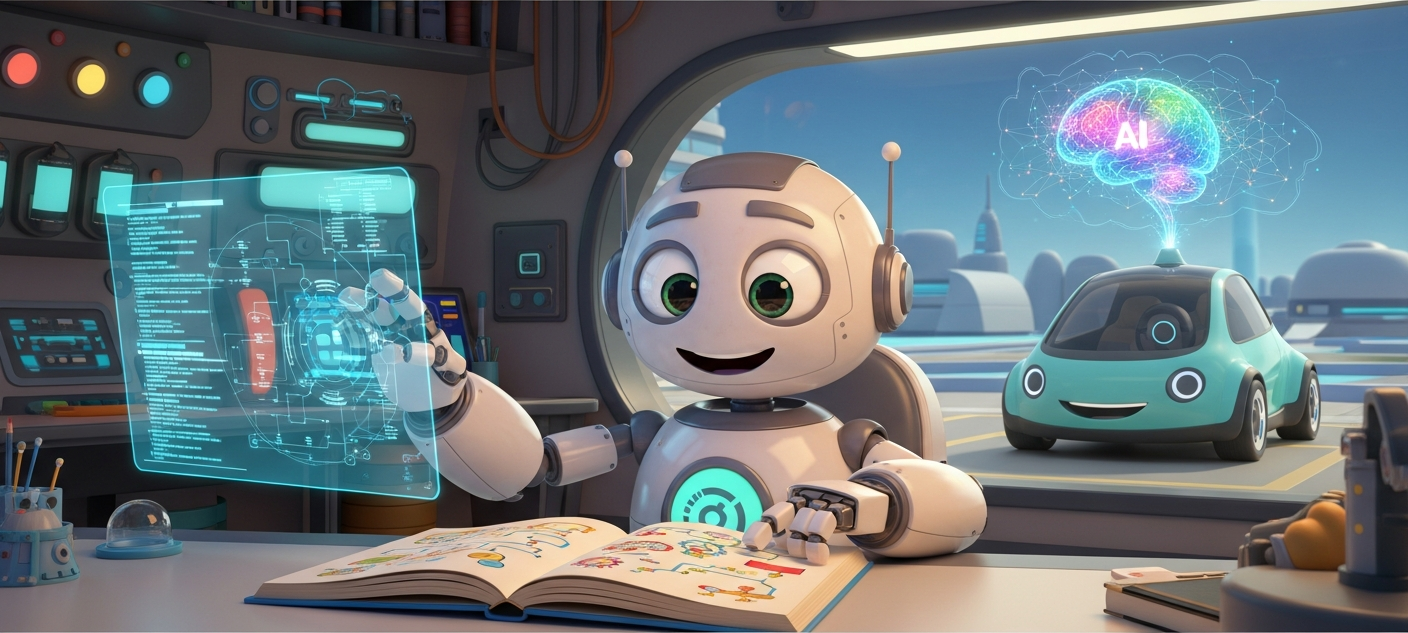
Google organized all the world’s information. But what if computers could do more than find answers — what if they could actually understand them?
The Bigger Dream
By the 2010s, Google had become part of daily life for billions of people. Search, Gmail, Maps, YouTube, Android — Google’s products touched almost every part of how humans use the internet.
But Larry Page and Sergey Brin had always dreamed bigger than search. From the very beginning, they believed that organizing information was just the first step. The real goal was to make computers truly intelligent.
Think about what Google Search does. You type a question, and it finds web pages that probably contain the answer. But Google doesn’t actually understand your question. It’s more like a super-fast librarian that can find the right book — but can’t read it for you.
What if the librarian could read the book, understand it, and explain it to you in your own words? That’s where Google wanted to go next.
A Game That Changed Everything
In 2014, Google bought a small company in London called DeepMind. DeepMind’s mission was simple but ambitious: solve intelligence.
DeepMind’s researchers started by teaching computers to play old Atari video games — Pong, Breakout, Space Invaders. The amazing part? They didn’t tell the computer the rules. The computer had to figure out the rules by itself, just by playing over and over and learning from its mistakes.
But the real jaw-dropping moment came in 2016. DeepMind built an AI called AlphaGo and challenged the world champion of Go — an ancient board game from China that’s considered one of the most complex games ever created.
Why was this such a big deal? Chess has about 20 possible moves at any point. Go has about 200. The number of possible Go games is larger than the number of atoms in the universe. Most experts said a computer wouldn’t beat a top human Go player for at least another decade.
AlphaGo won four games out of five.
The moment shocked the world. It wasn’t just about a board game. It proved that AI could learn to solve incredibly complex problems — problems that seemed impossible for machines.
Teaching Computers to “Read” a Sentence
AlphaGo won at Go. But there was still something computers were really bad at — understanding what people say.
Imagine you tell your mom: “My apple is broken.” What would she do? If you’re holding a piece of fruit, she’d say “throw it away.” If you’re holding a phone, she’d say “let’s get it fixed.” Your mom doesn’t just hear the word “apple” — she looks at the whole situation and instantly knows what you mean.
But old computers couldn’t do that. They read one word at a time, got to “apple,” and got stuck — are you talking about a fruit or a phone?
In 2017, Google’s Google Brain team published a new method called the Transformer. It let computers look at the whole sentence at once and instantly understand what you mean.
This invention changed everything. Almost every AI you’ve heard of today is built on top of what Google created.
AI You Can Talk To
Google launched Gemini in 2023. It doesn’t just read text — it can understand images and listen to your voice. It’s less like a search engine and more like a really smart classmate.
A kid came home from school, opened a computer, and took a photo of a math problem. He asked: “How do I solve this?” A few seconds later, a step-by-step explanation appeared on the screen. Not a search result. Not a link. The computer actually read the problem and explained it to him.
Google also quietly put AI inside everyday tools. When you search for “beach photos from last summer” in Google Photos, AI is recognizing your pictures. When you’re writing an email in Gmail, AI helps you finish your sentences. When you watch a YouTube video with auto-captions, AI is turning speech into text. When you point Google Lens at a menu in another language, AI reads and translates it for you.
The dream two students had in their dorm room was coming true. Computers weren’t just finding information anymore — they were starting to understand it.
Alphabet: The Bigger Picture
In 2015, Larry and Sergey did something surprising. They reorganized Google into a bigger company called Alphabet. Google became just one part of Alphabet, alongside other companies working on wild ideas.
There’s Waymo, building self-driving cars that can navigate city streets without a human behind the wheel. There’s Verily, using technology to fight diseases. There’s Wing, delivering packages with drones. And there’s DeepMind, still pushing the boundaries of what AI can do.
The story of Google is the story of a question that kept getting bigger. It started with “How do we find things on the internet?” It grew into “How do we organize all the world’s information?” And now it’s become “How do we teach computers to think?”
What comes next? Nobody knows for sure. But if two students in a dorm room could change how the world finds information, imagine what the next generation could build.
Did You Know?
- DeepMind’s AlphaGo made a move in Game 2 against the world champion that no human had ever played in the 3,000-year history of Go. Experts called it “Move 37” and said it was beautiful.
- Waymo’s self-driving cars have driven over 20 million miles on public roads — that’s like driving to the moon and back 40 times.
- Google’s Gemini can understand video. You can show it a cooking video, and it can tell you what ingredients are used in each step.
Think About It!
- Google’s AI beat the world champion at Go — a game people thought computers could never master. What’s something you think computers will never be able to do? Do you think you might be wrong?
- The Transformer was invented at Google but ended up powering products made by other companies too. Do you think it’s good when one company’s invention helps everyone, even competitors?
- Google’s AI can help doctors read X-rays and help scientists discover new medicines. What other jobs do you think AI could help with?