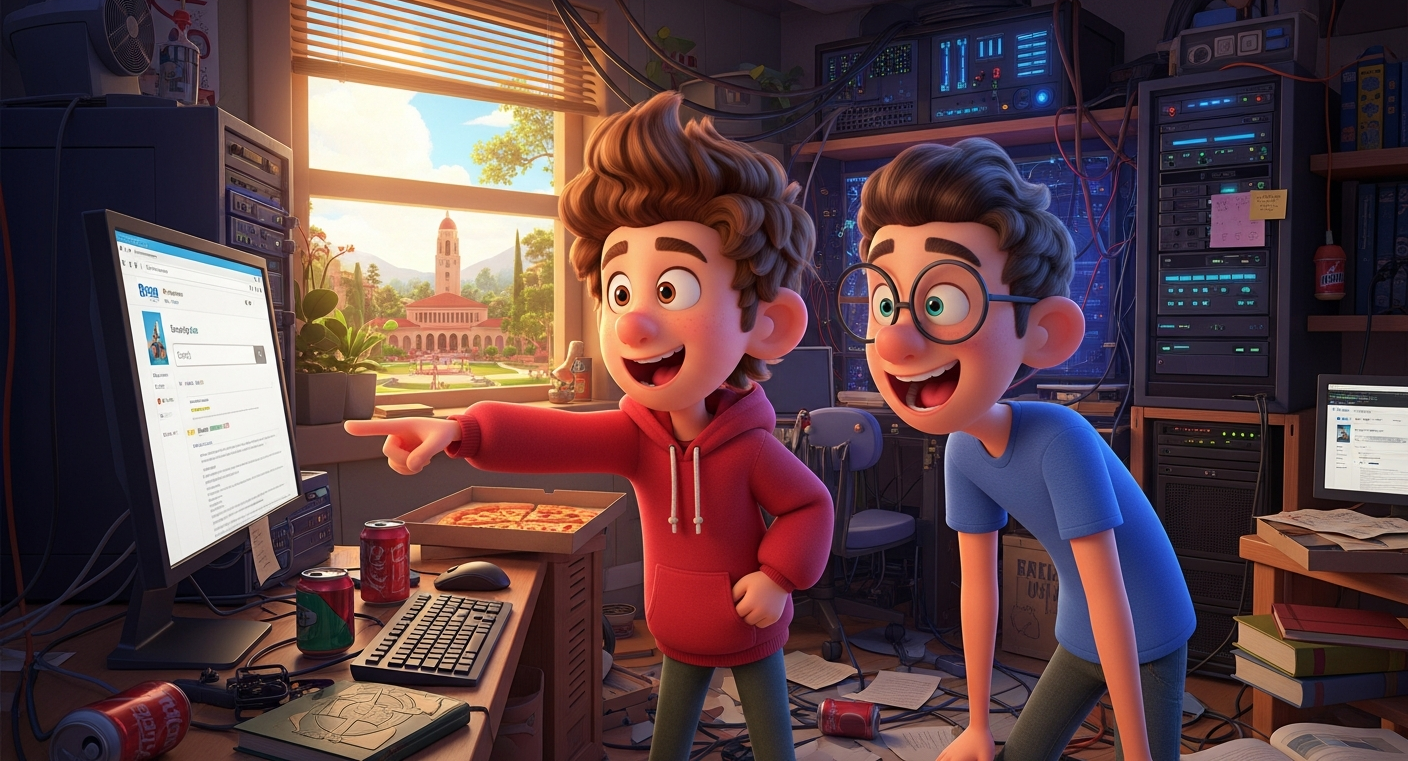
What if the entire internet was a giant messy room — and two college students figured out how to organize it?
The World’s Biggest Mess
Imagine a library with billions of books. But there’s no librarian. No catalog. No signs on the shelves. Every time you need to find something, you just wander around and hope you get lucky.
That’s what the internet was like in the mid-1990s. Websites were popping up everywhere — thousands of new ones every day. But finding what you actually needed? Nearly impossible. The “search engines” that existed back then were terrible. You’d type in a question and get a list of random, useless pages. It was like asking for directions and getting a phone book thrown at your face.
Two PhD students at Stanford University were about to change all of that.
Larry and Sergey
Larry Page and Sergey Brin couldn’t have been more different. Larry grew up in Michigan, the son of two computer science professors. He was quiet, thoughtful, and obsessed with big ideas. Sergey was born in Moscow, Russia, and his family moved to America when he was six years old. He was outgoing, energetic, and loved math puzzles.
They met at Stanford in 1995 when they were both in the computer science PhD program. At first, they had different ideas about almost everything. But that actually made things more exciting — one of them would toss out an idea, and the other would make it even better. They realized they were both fascinated by the same problem: how do you make sense of the internet?
The Brilliant Idea
Larry had a key insight. He noticed that the internet works a lot like academic research papers. When a research paper is really good, lots of other papers mention it and link to it. The more papers that reference it, the more important it probably is.
What if you could do the same thing with websites?
Think about it this way. Imagine you’re the new kid at school, and you want to find out who the best soccer player is. You could ask one person. But what if you asked everyone, and they all pointed to the same kid? That kid is probably really good.
Larry and Sergey built a system that worked exactly like that. Instead of just looking at the words on a website, their system looked at how many other websites linked to it. A page that thousands of websites linked to was probably more important than one nobody linked to.
They called this idea PageRank — partly named after Larry Page, and partly because it ranked web pages.
Born in a Dorm Room
Larry and Sergey started building their search engine in their Stanford dorm rooms in 1996. Their computers took up so much space and electricity that they kept blowing fuses in the building. Other students complained about the noise from all the humming machines.
At first, they called their search engine “BackRub” (because it analyzed “back links”). Not the catchiest name, right? They soon changed it to Google — a play on the word “googol,” which is the number 1 followed by 100 zeros. They chose this name because they wanted to organize a seemingly infinite amount of information.
They tested Google on Stanford’s campus, and word spread fast. Students couldn’t believe how good it was. You’d type in a question, and Google would give you exactly what you were looking for — not a random mess of pages, but the most relevant, most useful results.
From Dorm to Garage
By 1998, Larry and Sergey knew they had something special. But to keep the search engine running, they needed money — a lot of it.
One day, they brought a laptop to meet a famous tech founder named Andy Bechtolsheim. They opened Google and searched for a few things. Andy looked at the screen, pulled out his checkbook, and wrote a check for $100,000 right on the spot. But here’s the funny part — he made the check out to “Google Inc.,” a company that didn’t even exist yet! They had to rush to officially create the company before they could take the money to the bank.
On September 4, 1998, Google Inc. was born. Their first office? A garage in Menlo Park, California — just like Apple two decades earlier. Inside, they set up a bunch of servers and a ping-pong table. And just like that, they got to work.
Growing Like Crazy
Google was an instant hit. By the end of 1998, it was handling 10,000 searches per day. That sounds like a lot — but it was just the beginning. Within a year, that number jumped to 3.5 million per day. Then 60 million. Then hundreds of millions.
Imagine you need to do a report on dinosaurs. Before Google, you’d search for “dinosaurs” and get a website selling dinosaur toys, a broken link, and a research paper you couldn’t understand. But with Google? The first result was exactly what you needed.
That’s why people fell in love with Google.
By 2000, Google was the most popular search engine in the world. Two PhD students who thought differently about almost everything had built something together that changed how everyone on Earth finds information.
And they were just getting started.
Did You Know?
- Google’s first server was built from LEGO bricks. Larry and Sergey used LEGO to build a case for their hard drives because it was cheap and colorful.
- The original Google homepage was super simple — just a search bar and a logo — because Larry and Sergey didn’t know how to make a fancy website. That simple design became one of the most recognized pages on the internet.
- Google handles over 8.5 billion searches every single day. That’s more than one search per person on Earth!
Think About It!
- Before Google, finding information online was really hard. Can you imagine what it would be like to use the internet without a search engine?
- Larry and Sergey had very different ideas when they first met. Do you think having different opinions can sometimes lead to great ideas? Why?
- Google’s first office was a garage. What does that tell you about where great companies can start?