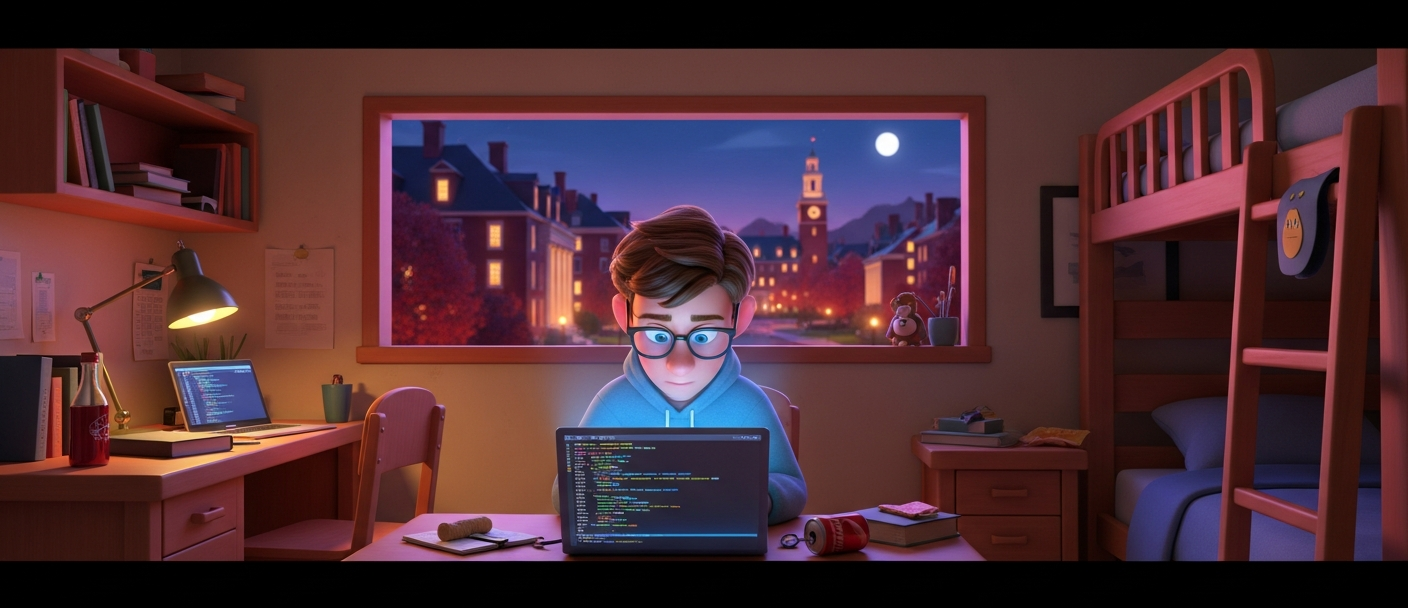
What if one college student built a website in his dorm room — and it connected the entire world?
The Idea in the Dorm Room
In 2003, Mark Zuckerberg was a sophomore at Harvard University. He was a computer science student who loved building things. Not with wood or metal — with code. He’d been programming since middle school, and by the time he got to Harvard, he could build a website faster than most people could write an essay.
Harvard had a problem that bugged Mark. The university didn’t have an online directory where students could see each other’s photos and profiles. At most schools, there was a physical book called a “face book” — a printed booklet with every student’s name and photo. But there was no digital version.
Students wanted to know who was in their classes, who lived in their dorm, who shared their interests. In a university with thousands of students, it was easy to feel lost.
Mark decided to fix this himself.
TheFacebook
On February 4, 2004, Mark launched a website from his dorm room. He called it TheFacebook. The idea was simple: Harvard students could create a profile with their photo, their name, what they were studying, and their interests. Then they could connect with other students — see who was in their classes, find friends of friends, and send messages.
To sign up, you needed a Harvard email address. That was it. No fancy features. No games. Just a clean, simple way to see who was around you.
Within 24 hours, over a thousand Harvard students had signed up. Within a month, more than half of all Harvard students had a profile.
Spreading Like Wildfire
Mark’s roommates — Eduardo Saverin, Andrew McCollum, Dustin Moskovitz, and Chris Hughes — helped build and run the site. As word spread, students at other universities started begging to be included.
TheFacebook expanded to Columbia, Stanford, and Yale. Then to all Ivy League schools. Then to universities across America. Each time it opened to a new school, it followed the same pattern: slow at first, then explosive.
By the end of 2004, TheFacebook had over 1 million users. And Mark was only 20 years old.
The name was shortened to just Facebook. It was growing so fast that Mark felt he couldn’t wait — if he stayed in school, he might miss the moment. So he dropped out of Harvard (following the footsteps of Bill Gates, who’d done the same thing decades earlier) and moved the company to Palo Alto, California — right in the heart of Silicon Valley, where the best investors, engineers, and tech companies in the world were all within a short drive.
Opening the Doors to Everyone
For its first two years, Facebook was only for college students. You needed a university email to join. This made it feel exclusive and special, like a club.
But in September 2006, Mark made a huge decision: he opened Facebook to everyone. Anyone over 13 with an email address could sign up.
The decision was brilliant. Within a year, Facebook went from 12 million users to 50 million. Parents joined. Grandparents joined. High school students joined. People in countries all over the world joined.
Facebook became the place where you shared photos from your vacation, wished friends happy birthday, organized events, and reconnected with people you hadn’t seen in years. That kid you sat next to in first grade? They’re on Facebook. Your cousin in another country? Facebook. Your teacher from summer camp? Facebook.
By 2008, Facebook passed 100 million users. By 2010, it hit 500 million. It was growing faster than any website in history.
News Feed: Open the App and Know What Everyone’s Up To
Imagine having to walk to 30 of your friends’ houses every day, ring each doorbell one by one, and ask: “What did you do today?” That sounds exhausting, right? That’s what early Facebook was like — you had to click into each friend’s page one by one to see what they’d posted.
In 2006, Facebook launched the News Feed. Now when you opened Facebook, you could see all your friends’ latest updates — where they went, what photos they took, what funny things they said — all showing up automatically on one page.
At first, a lot of people weren’t used to it. They thought it was weird to see everyone’s stuff the moment they opened the app. But after a few weeks, nobody could live without it.
A Billion Friends
By 2012, Facebook reached an incredible milestone: 1 billion users. One out of every seven people on the planet had a Facebook account. No website, no service, no company had ever connected that many people before.
Mark Zuckerberg, the kid who’d been coding since middle school, had built something entirely new in human history — a place where more than a billion people could share their lives, stay in touch with loved ones, and feel connected to the world around them.
And he was still only 28 years old.
Did You Know?
- The very first version of TheFacebook was built in just about two weeks. Mark coded most of it himself in his Harvard dorm room.
- Facebook’s signature blue color wasn’t a design choice — Mark Zuckerberg is red-green colorblind, and blue is the color he sees best.
- The “Like” button was introduced in 2009 and became one of the most recognizable symbols on the internet. Today, billions of Likes are given every day.
Think About It!
- Facebook started because Mark wanted to solve a simple problem at his school. Can you think of a problem at your school that could be solved with technology?
- The News Feed was hated at first but became Facebook’s most popular feature. Have you ever disliked something new at first but then loved it later?
- Facebook connected people who hadn’t seen each other in years. If you could reconnect with anyone from your past, who would it be?