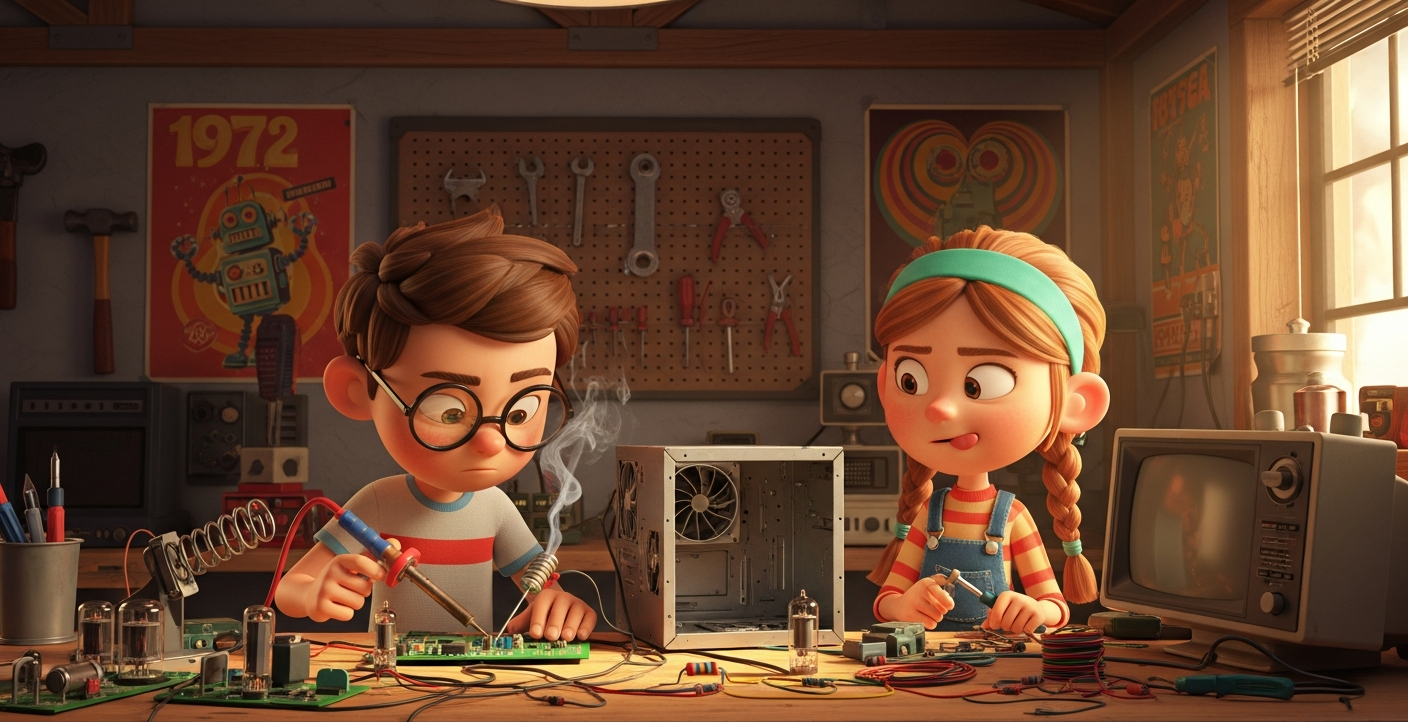
What happens when two kids who love building things meet — and decide to change the world from a tiny garage?
The Kid Who Was Different
Steve Jobs was a kid who couldn’t stop asking questions. He wanted to know how everything worked — why TVs glowed, how radios picked up sound, what made machines tick.
He was wildly curious about how things worked — especially electronics. Growing up in Mountain View, California, right in the heart of what would become Silicon Valley, he was surrounded by engineers and tinkerers. His dad, Paul Jobs, had a workbench in the garage where he fixed cars and built things. Steve watched.
One day, a neighbor who worked at a tech company showed young Steve a computer. It was huge, clunky, and could barely do anything by today’s standards. But to Steve, it was magic. A machine that could think? He had to know more.
The Other Steve
Around the same time, another kid in the same neighborhood was even more obsessed with electronics. Steve Wozniak — everyone called him “Woz” — was a true genius with circuits and wires. While other kids played sports, Woz was building computers from scratch in his bedroom.
Woz didn’t just understand technology. He could make it do things nobody thought possible. As a kid, he built a tic-tac-toe machine out of transistors, resistors, and diodes — a homemade box with 100 tiny rules programmed in, so the machine could play against you and never lose. Imagine building your own robot opponent out of spare parts!
When Jobs and Woz met through a mutual friend, something clicked. Jobs was the dreamer — the one who could see what technology could mean for regular people. Woz was the builder — the one who could actually make it. Together, they were unstoppable.
A Computer for Everyone
In the mid-1970s, computers were enormous machines that filled entire rooms. Only big companies and universities had them. The idea that a regular person could have a computer at home? Most people would have laughed at you.
But Jobs and Woz had a radical idea: what if computers were small enough to fit on a desk? What if anyone could use one?
Woz got to work. In his spare time, he designed a small computer that was shockingly powerful for its size. He called it the Apple I. It was basically a circuit board — no screen, no keyboard, no case. You had to add everything yourself. It looked like something from a science experiment.
But Jobs saw the potential. He didn’t just see a circuit board. He saw the future.
Born in a Garage
On April 1, 1976 — yes, April Fools’ Day! — Steve Jobs, Steve Wozniak, and their friend Ronald Wayne officially created Apple Computer Company. Jobs was just 21 years old. Woz was 25.
Their first office? The Jobs family garage in Los Altos, California. It was cramped, messy, and smelled like solder. But it was theirs.
Jobs convinced a local computer store to order 50 Apple I units. That was their first real customer! The problem? They didn’t have the money to buy the parts. Jobs sold his Volkswagen van. Woz sold his beloved calculator. Together they scraped together enough to build those 50 computers by hand.
Each Apple I sold for $666.66. They made enough money to keep going.
The Apple II Changes Everything
The Apple I was impressive, but it was still for hobbyists and tinkerers. Jobs wanted something bigger. He wanted a computer that your mom, your teacher, or even your grandma could use.
In 1977, Apple released the Apple II. And it changed everything.
The Apple II came in a sleek plastic case — not a bare circuit board. It had a keyboard built in. You could connect it to your TV. It had color graphics! At a time when most computers showed nothing but green text on a black screen, the Apple II could display colors like a painting.
Schools started buying them. Businesses started buying them. Families started buying them. The Apple II became one of the first truly successful personal computers in history.
Apple went from two guys in a garage to a real company with hundreds of employees. By 1980, when Apple sold shares on the stock market for the first time, the company was worth $1.2 billion. Jobs and Woz had proven that a wild idea born in a garage could change the world.
The Lesson of the Garage
Here’s the thing about Apple’s beginning that matters most: it didn’t start with billions of dollars or a fancy laboratory. It started with two friends, a shared passion, and a garage.
Jobs and Woz didn’t wait for permission. They didn’t wait until they were older or richer or more experienced. They just started building. And when they ran out of money, they sold what they had and kept going.
That garage in Los Altos is still there today. It’s now a historic landmark — proof that the biggest ideas can come from the smallest places.
Did You Know?
- The name “Apple” was chosen by Steve Jobs after he visited an apple farm. He thought it sounded “fun and not intimidating.”
- The Apple I was hand-built. Steve Jobs, Steve Wozniak, and their small team soldered every single circuit board by hand.
- The Apple II stayed on sale for an incredible 16 years — from 1977 to 1993.
Think About It!
- Jobs was the dreamer and Woz was the builder. Which one are you more like? Why?
- Apple started in a garage with almost no money. What’s a big idea you could start working on right now, even without fancy tools or a lot of resources?
- The Apple II was special because it was designed for everyone, not just experts. Can you think of something in your life that used to be only for experts but is now for everyone?