“We are not really an internet company. We are a customer company that uses the internet.” — Jeff Bezos
A Bold Question
In the early 2000s, Amazon was super successful at selling books. Every year, millions of them sold. More and more customers kept coming. Business was great. You’d think: just keep selling books, right?
But then Bezos asked a bold question: “What if we sold everything?”
CDs, DVDs, toys, clothes, sports equipment, kitchen stuff—basically anything you could imagine. It sounds crazy. Amazon was good at books. Books are flat. They don’t break easily. They’re easy to pack. But bicycles? Birthday candles? A thousand different shoe sizes? Each product has different storage needs, different packaging challenges, different shipping problems. This was like learning a whole new business from scratch.
The Birth of The Everything Store
Bezos wasn’t scared. He started with things most like books: CDs and DVDs. Those are also flat and easy to ship. After success with those, he challenged electronics. Then toys. Then clothes. Step by step, like beating levels in a video game, unlocking new product categories.
By 2005, you could buy almost anything on Amazon. Bezos called it “The Everything Store”—sounds powerful, but the challenges behind it were enormous.
Think about it: you can’t put a bicycle, potato chips, and a phone case on the same shelf. Amazon had to build warehouse after warehouse across the US. Each one had its own system to track where every product was, how to pack it, and how to get it to customers as fast as possible. This wasn’t just “selling more stuff.” It was building a whole logistics system that had never existed before.
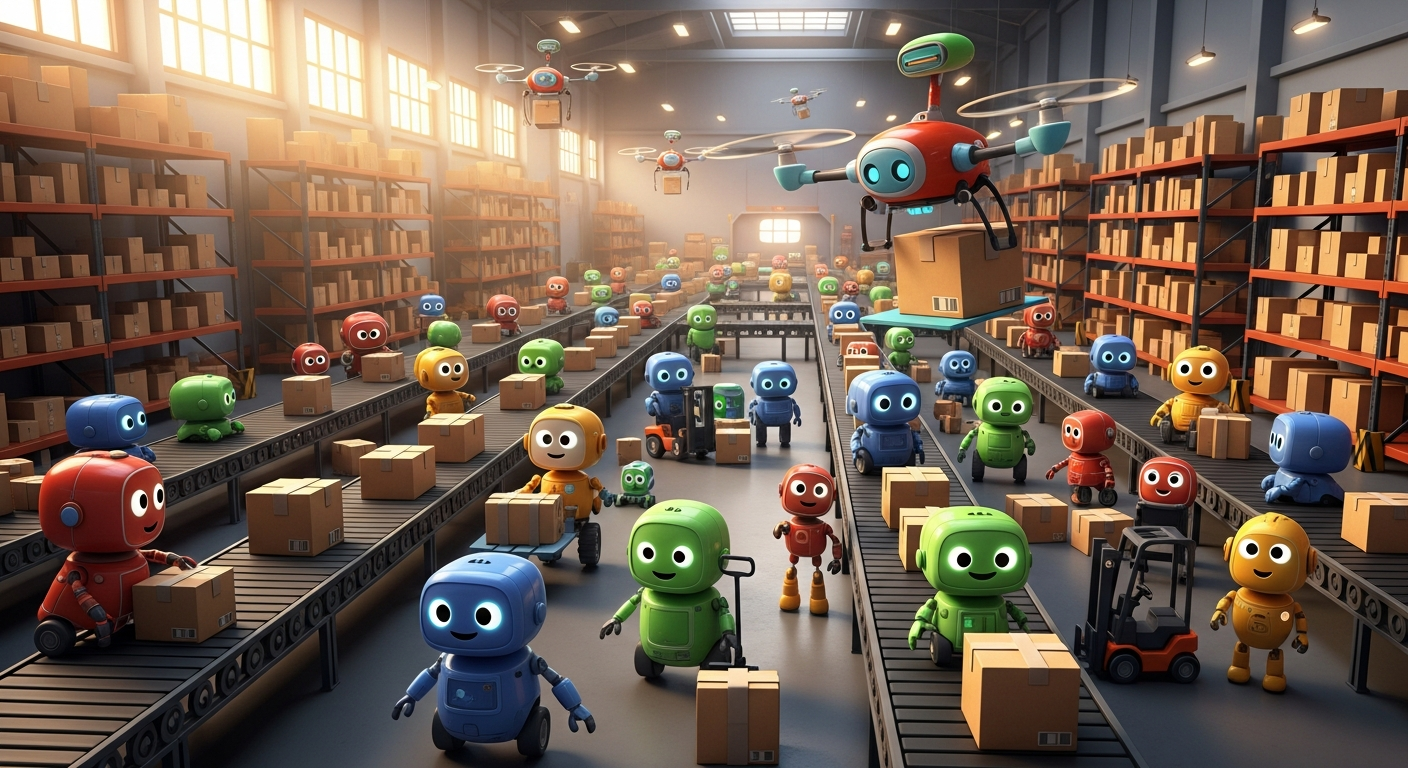
The Robot Army Moves Into the Warehouse
How big are Amazon warehouses? Some are bigger than five football fields combined. Inside are millions of items—everything from phone cases to baby formula.
Here was the problem: a customer orders a jar of peanut butter. A worker has to find it in this huge space, walk over to get it, walk back, and pack it. If the warehouse is enormous, a worker might walk over 20 kilometers in a single day—that’s like walking to school and back several times!
In 2012, Amazon bought a robotics company called Kiva Systems and came up with an incredibly smart solution: instead of people going to find products, the products would come to the people.
Orange robots, about as flat as a robot vacuum but incredibly strong, scoot under the shelves, lift up entire shelf units, and carry them like ants carrying food. All the way across the warehouse, straight to the worker. The worker just stands in one place, reaches out, and grabs the item they need. Done!
The coolest part? These robots never crash into each other. They navigate using barcodes on the floor, hundreds of them working at the same time—it’s like a perfect dance. Thanks to these tireless robots that never complain or get tired, Amazon can pack things faster. When you order something and it arrives the next day, those orange robots are the unsung heroes behind it.
Prime: The Game-Changer
In 2005, Amazon introduced Prime. This was genius-level thinking.
The problem Amazon was solving: When you ordered something, it took 5 to 7 days to arrive. That was actually pretty fast for mail-order shopping back then. But sometimes people needed things faster. And sometimes they were frustrated about paying for shipping.
Amazon’s solution was Prime. Pay a yearly fee (originally $79), and you get free two-day shipping on most orders. Later, they made it even faster—next-day shipping. Then same-day shipping in some cities. Today in some places, you can order something in the morning and have it by evening.
Here’s the surprising part: at first, people thought Prime was a terrible idea. Amazon was already losing money on shipping. Why lose even more? But Bezos was thinking long-term. He said: “We’ll lose money on each delivery, but customers will order more often and buy more stuff. In the end, we’ll make more money.”
He was right. Prime became hugely popular. Today, over 150 million people worldwide pay for Prime.
Kindle: A Library in Your Pocket
Imagine this: a device thinner and lighter than a textbook that holds over 6,000 books. That’s an entire small library in your backpack! And the battery lasts for weeks because Kindle uses “e-ink” technology that looks like real printed paper on a page, not glaring like a phone screen.
Many people resisted at first. “But I like turning pages!” “I like the smell of new books!” they said.
But Kindle solved real problems. Text too small to read? You can make it bigger. See a word you don’t know? Tap it, and the dictionary definition pops up without leaving the page. Want to read at night? Kindle has a built-in light so you don’t need to turn on your bedroom light. And ebooks are usually cheaper than paper books—some classic books are even free.
The coolest part: you can buy a new book in 60 seconds and start reading immediately. No trip to the bookstore. No waiting for delivery. Want to read something? Read it right now, anywhere, anytime.
Kindle became incredibly popular. Amazon went from just selling books to controlling how people read and publish books.
What Did Amazon Change?
Think about how your parents shopped when they were kids: drive to a store, walk around looking for what you need, wait in line to pay, drive home. Buying one thing could take an entire afternoon.
Now? Lie on your couch, scroll your phone, tap once, and it shows up at your door tomorrow. This isn’t just “more convenient.” Amazon truly changed people’s expectations about shopping. People started feeling: delivery should be fast, returns should be easy, selection should be huge. These “should be” expectations were built by Amazon, step by step.
More Than Just a Store
By the 2020s, Amazon was no longer just an “online store.” It became a vast empire reaching places you wouldn’t imagine.
Want to watch a movie? Amazon has Prime Video, producing its own films and shows. Hungry? Amazon bought the upscale supermarket Whole Foods and started selling fresh groceries. Companies worldwide need powerful computers to run their websites and apps? Amazon’s cloud service AWS quietly powers a huge portion of the internet world.
A small company that started in a garage selling books became a giant affecting the daily lives of billions.
Did You Know?
- The Kiva robots look small and flat, but they can lift shelves weighing over 1,300 kilograms—about the same as a small car.
- After Kindle was invented, ebook sales surged, changing how people read and buy books.
- Prime members worldwide exceed 150 million, making it the most successful subscription service in retail.
Think About It!
- If Amazon hadn’t expanded beyond books, what would online shopping look like today?
- Why is speed (two-day, next-day, same-day delivery) so important to the shopping experience?
- What are the advantages of ebooks versus physical books? If you could choose, which way would you prefer to read?