“I want to build something that will last a thousand years.” — A 30-year-old named Jeff Bezos, before he quit his job to sell books on the internet
The Story Begins
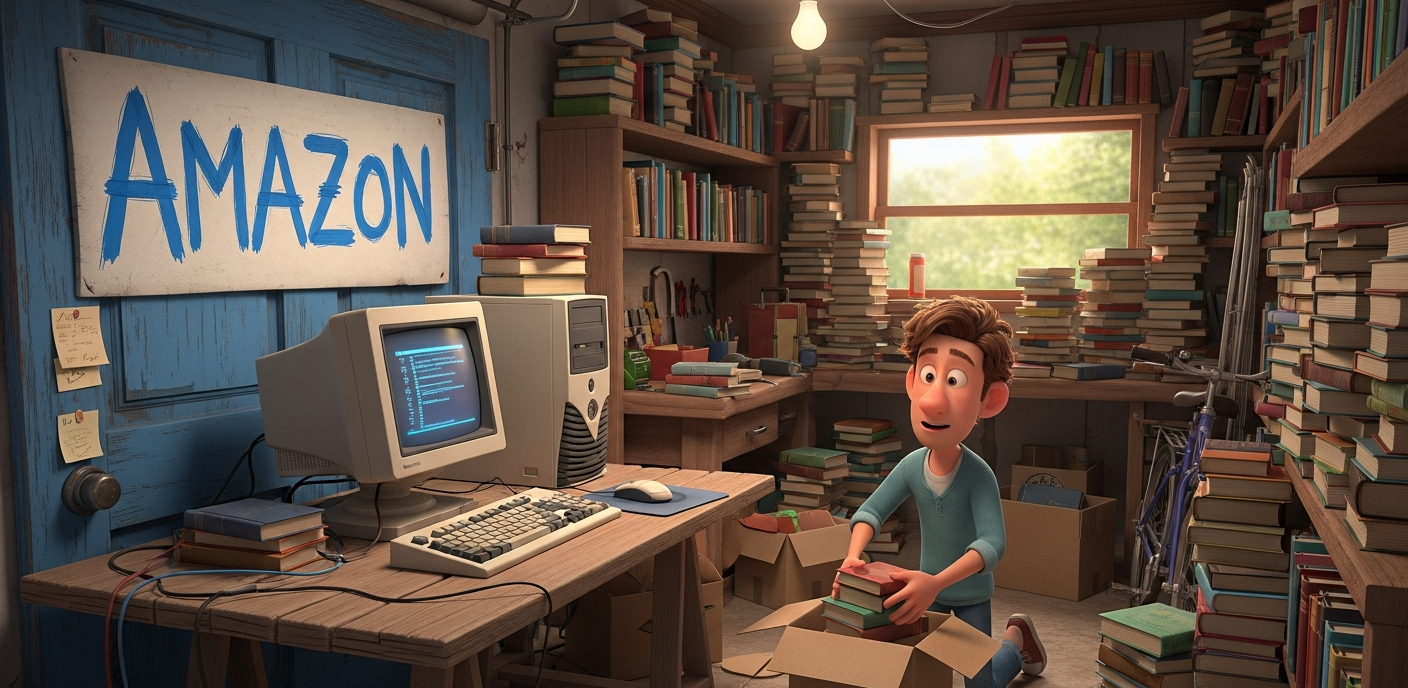
Imagine you’re walking through a garage in Seattle, Washington, on a cold morning in 1994. The year is important, because back then, most people didn’t know what the internet even was.
But inside this little garage, an energetic young man named Jeff Bezos was doing something that nobody else was doing. He wasn’t an inventor who created a new product. He wasn’t a chef opening a fancy restaurant. He was… selling books. Books from a garage. Books on the internet. And this one idea would change the world forever.
The Wall Street Kid Who Dreamed of the Internet
Jeff Bezos was smart—really smart. He loved reading, loved problem-solving, and loved thinking about the future. As he got older, he studied computer science and engineering in college, then went to work on Wall Street in New York. Wall Street is where people work with money and investments, and Bezos was good at his job. He made decent money. He had a nice apartment. Most people would have stayed.
But Bezos kept thinking about something: the internet was growing. It was growing FAST. In 1994, maybe 50 million people had access to the internet. That doesn’t sound like a lot now, but back then, it was revolutionary. Bezos thought: What if I used the internet to sell something?
Bezos thought carefully about what to sell first. He made a list of twenty products, then narrowed it down to one: books. It was a brilliant choice. Books don’t break in the mail. They’re small and easy to ship. There are millions of titles in the world—way too many for any regular bookstore to keep on its shelves. An online store could offer them all. And best of all, people who love reading will happily wait a few days for the perfect book.
The Crazy Decision
Before making his decision, Bezos did something smart. He talked to his boss, David Shaw. Shaw was a very smart man. He took Bezos for a walk through Central Park in New York and said: “This is a good idea. But it’s a better idea for someone who doesn’t already have a good job.”
Bezos went home and thought about it for two days. Then he used a method he called the “regret minimization framework.” He imagined himself at 80 years old, sitting in a rocking chair, looking back on his life. Would his 80-year-old self regret not trying this? The answer was clear: yes. He absolutely would regret it. He wouldn’t regret failing, but he would definitely regret never trying.
In 1995, at age 30, Bezos did something most people thought was insane. He quit his job. He left his salary, his job security, everything. He packed his car and drove from New York to Seattle, Washington. While his wife drove the car, he worked on his laptop—writing the code, the computer instructions, that would become Amazon.
He called the company Amazon after the Amazon River in South America. Why? Because the Amazon is the world’s largest river, and Bezos wanted to create the world’s largest bookstore. Clever, right?
The garage where Amazon started was small and cramped. Books were piled everywhere. Bezos worked there with a few friends, packing books, printing addresses, and carefully wrapping each order. There was no fancy warehouse. No robots. No trucks with the Amazon smile logo on them. Just a garage, some books, and the belief that people would buy books from a computer screen.
The Wild West Internet Days
Here’s what makes this part of the story amazing: most people thought Bezos was crazy. Really crazy. Why would anyone buy a book from a computer when they could go to their local bookstore? Why wait days for delivery when you could just drive five minutes down the road?
But Bezos had figured out something important. Online, he could offer books that your local bookstore didn’t have. He could offer them cheaper. He could let you read what other people thought about the book before you bought it. And here’s the key: people who loved reading, who wanted rare books or specific titles, would be willing to wait a few days to get them.
In 1995, when Amazon first went online, they made their first sale. A book about computers. The customer? One of Bezos’s friends. But it was a start.
By 1997, Amazon was selling thousands of books every day. The company still wasn’t making much profit—in fact, it was losing money. But Bezos didn’t care. He wanted to grow. He wanted more customers. He wanted people to trust him. So he lowered prices. He offered free shipping sometimes. He did everything to make customers happy.
Wall Street investors thought he was crazy again. How can you make money if you keep losing money? But Bezos kept saying: “We’re not focused on profit. We’re focused on customers. Profit will come later.”
The Packing System That Worked
One thing that surprised people was how well Amazon packaged books. Bezos understood that a book arriving damaged wasn’t a book at all. So he tested different packaging methods, different boxes, different materials. The team created a system where books arrived safely. They would even include a personalized note sometimes.
The warehouse where they packed books grew bigger. They hired more people. They moved from the garage to a real warehouse. But the idea stayed the same: treat every customer like they’re the only customer. Pack carefully. Ship fast. Make people want to order again.
The IPO Moment
In May 1997, Amazon sold shares of the company to the public for the first time. The stock price went up. Suddenly, Bezos and his team had real money to expand. They could open warehouses in different cities. They could advertise. They could hire smart people to improve the website.
And they did. Amazon grew. And grew. And grew.
Why This Mattered So Much
You might be wondering: why is selling books on the internet such a big deal? It’s because it proved something important. It proved that people would trust the internet for shopping. It proved that you could build a massive business online. It proved that if you treat customers right, they’ll keep coming back.
When Bezos started Amazon in that garage, the internet was new and weird and scary to most people. But he believed in it. He believed that one day, instead of going to a store, people would sit at home and order things on their computer, and those things would arrive at their door.
In 1995, that was crazy talk.
By 2000, it was becoming normal.
Did You Know?
- In 1995, most homes didn’t have internet. Today, over 5 billion people worldwide can go online.
- When Amazon first started, a bell rang in the office every time someone placed an order. After a few weeks, they had to turn it off because it wouldn’t stop ringing.
- The Amazon logo has a smile-shaped arrow pointing from A to Z, meaning they sell everything—from A to Z.
Think About It!
- If Bezos hadn’t quit his Wall Street job, would Amazon exist? Sometimes big changes require big risks—do you agree?
- Bezos kept expanding even while losing money. When you believe in something, are short-term losses worth it?
- If you were in 1995, would you believe people would buy things online? How do you decide whether to trust new technology?